
Thad Blanchard Sr. was my great-uncle. His sparkle and zeal for life were as spirited as his advocacy for veterans. For our expansive family, he made reunions a joy, and could be found dancing, laughing and whisking the smallest away to spread cheer with him – he loved babies. His warmth was such that you immediately felt loved and cared for when he greeted you. Thad was a warrior-poet who lived each day to the fullest.
His son Kevin had just finished updating Thad’s autobiography the Saturday before he passed. According to Kevin Thad had started writing it in 1972 to deal with the flashbacks and nightmares he suffered from his time fighting in WWII.
His story is enlightening.
With his son’s permission, I am sharing it with you so you too can be touched by the life of a man who was always the hero he never claimed to be.
–Ron Lee, Editor, US~Observer
Airborne!!

My name is Thad Everett Blanchard Sr.
I was born on Friday, March 3rd, 1922, in Hansen, Idaho, and I was the 12th and youngest born child of Don Carlos and Geneverie Jane Blanchard.
When I was a 3-year-old toddler living in Hansen, my Mother was out in the yard hanging clothes she had hand-washed on a scrub board. With 12 children, she had done a lot of laundry that day. I came out onto the second-story landing above where she was hanging the laundry when I slipped and slid across the deck, right under the railing. Mom saw me coming. She threw down the sheet she was about to hang on the line, spit out the clothespins in her mouth, kicked over the laundry basket, and tried desperately to catch me. I hit the second clothesline and bounced to the third clothesline. It caught me flat on my back and inside my right leg, raising a long red mark before the clothesline broke, dumping me on the ground and knocking the wind out of me. Mom grabbed me up and ran up the stairs two at a time. She slapped my back and asked if I was alright. I couldn’t answer and was afraid to even if I would have been able to. Especially since I thought about all those clothes and all that hard work of washing them by hand that she would have to redo, and I thought surely I was going to get my butt tanned for messing it all up.
After she stripped me and checked for any broken bones while simultaneously trying to explain to my sisters what had happened, we sat rocking in the little wooden rocker that eventually ended up in my own home as an adult.
Isn’t it funny how the Baby of the family gets away with Love and Forgiveness?
Little did I know that episode would be my first attempt to become a Paratrooper.
My father and mother were two of the hardest-working people I’ve ever known.
I seldom saw my father because he was on the road with a twenty-horse team hauling freight and equipment to mines and mills all over the country. I recall seeing those horses coming into town, the bells on the lead team ringing, and how they responded to my dad’s commands and the touch of the reins. Dad would take them into the woods, hook them to logs, tie up their reins, and send them down to the mill, where they would be unhitched from the logs and return to Dad without guidance.
Homer Holcomb, the world-famous rodeo clown, drove a team for my dad’s freight line, as did my two brothers-in-law, Everett and Charles Lish. They were all great friends and talented musicians who would play for the local dances.
Dad and the crews built roads using as many as 60 teams of horses. Dad’s keen eye for level made him the road finisher.
After the road and mill work declined, Dad and my older brothers moved to Nevada to harvest wild hay. It was during this time that our family was separated for nearly a year.
During the year in Nevada, Anthrax hit the country, and all of Dad’s horses had to be destroyed. The trauma of losing his horses stayed with him through the years.
After Dad and the boys had spent about a year in Nevada, Dad got a job as foreman of the Peoples Ranch in Fernley, Nevada. This is where our family was reunited again with hugs, kisses, and us little ones getting tossed high in the air.
Mom was an ex-school teacher, gardener, homemaker, and all-around go-to for our family. Her tales of riding miles to teach in Montana blizzards and being chased by Indians and wolves made life eventful for her during that time. I can still remember seeing her near-bleeding fingers from doing all those mounds of laundry and other chores she so unceasingly did to care for our family.
The one lesson we all learned early in life is that if a job put food on the table, clothes on your back, and a roof over your head, then it was worthy.
Times were changing, new machinery was coming onto the scene, and soon Dad and the crews were out building roads in Nevada and Utah.
On a summer jaunt to Reno to buy a new car, five of us younger kids got to tag along. Reno was having an air show that day. My older brother Irvin thought he and I should take a plane ride. I was so small that I was looking down at the ground through the crack of the open cockpit door.
When we landed, we watched the son of the very man my dad was buying the new car from take a parachute jump. I was totally fascinated, and somewhere deep in my mind I thought I could do that someday. Not realizing that years later I’d be making parachute jumps, albeit not under such MILD circumstances.
Eventually, after years of road building, we ended up on the Freeman Ranch in Stillwater, NV, where Dad was again a foreman. They had horses, and Dad was back to working with the animals he loved so much. He had a magical understanding and touch with those horses. He tried to teach me the art, but there was very little horsemanship in me. I didn’t doubt my dad was disappointed.
But being from a road-construction family that uses heavy equipment, I was mesmerized by it all, and I would make a complete nuisance of myself at the work sites. Eventually, my dad and brothers taught me everything there is to know about each piece of equipment. I would soon be spending summers building roads along with them.
I was the sole graduate from the old two-room schoolhouse in Stillwater, NV.
Soon after graduation, my parents bought a little acreage in the Lone Tree District. Dad and I finished building our house on it.

I worked milking cows, digging a cellar, and even driving a school bus while attending Fallon, NV high school.

My dad got a huge urge to buy a new team of horses. He was buying them from a local farmer named Lorenzo Mori. When Mr. Mori showed up with the horses, he had his little freckled-face daughter (Rosa) Rosie with him. I had no idea that she would eventually become the mother of my children and the love of my life.
My dad had a vivid dream about a mine. After exploring an area outside Lovelock, NV, he found a natural monument he had seen in his dream. So, he and Mom ended up moving to Toy, about twenty miles from Lovelock. I would stay in Fallon and live with my sister Jo and her husband Bill Lee to finish high school.
Dad had to give up his mining dreams when his arms could no longer stand the strain of picking and digging.
That summer I went to work for Dodge Construction in Imlay, NV, and a week later they sent me to Gardnerville on a new job. The next winter I was back in Fallon finishing High School and dating that little freckled-face Rosie.
After graduation, I went to work in Battle Mountain with my dad, driving a dump truck in a mine. I just couldn’t stand not having my little freckle-face around, so Mom, Dad, and I took off to Fallon. I asked “Freckle-Face” to marry me.
Rosie and I were married at her parents’ ranch house, where she was born. Rosie’s mother, who was cooking for a large hay crew at the time and didn’t need any additional work, stepped up and cooked us a meal fit for a king. I’ll always remember the taste of that homemade pasta and her special sauce!

That night Rosie and I took a honeymoon train ride from Hazen to Reno — a whole 50 miles. My dad and mom dropped us at the train station, then headed back to Battle Mountain. Rosie’s dad drove to Reno to pick us up the next day. Then it was back to Battle Mountain for us to work. So, we loaded up our worldly possessions in a secondhand steamer trunk and Rosie’s cedar chest and shipped them to Battle Mtn.
We would have to wait for another week’s paycheck to pay the $6.00 shipping fees at the freight station.
A friend, Chick Thomas, came to Battle Mountain and talked us into moving to the Crown Mine to work for him.
So, Rosie and I packed up. When we got there and saw the desolation at the mine, Rosie said, “I guess we know what Hell looks like.”
We had found an old railroad train boxcar out in the desert. We used Chick’s old 1918 white truck to tow it to the new location. Chick had set up a site for us with running water and an outhouse. It was a two-holer no less! Who needs a two-holer?
Rosie found an old wood cook stove that had been tossed out into the desert, and we moved it into the boxcar. The first night she tried to cook our first dinner in it; well, I got back just in time to run for the water bucket. The bottom was rusted out, and it burned clear through the bottom of the boxcar. I found a metal plate and reinforced its bottom so we could use it. It was so warped and uneven that when she made her first cake in it, it was a complete disaster, leaking all over the oven.
But we made it our home. It had running water. Just outside the door was a faucet. Our kitchen had a table and two benches, crudely made with two-by-fours and rough lumber, well-worn and oily. There was a sink of sorts, so at least the water could be drained outside and not carried back out. A couple of open cupboards and an 8’ x 8’ bedroom that was a beauty! A bed made of two-by-sixes with a battered coil spring and a not-too-clean mattress. A refrigeration cooler made from an old orange box and covered with gunny sacks, making it a neat place to store eggs and whatever else we could keep for a day or two.
While I worked at the mine, Rosie would bring me lunch each day and sometimes ride along with me in the dump truck.
One day Chick picked Rosie up at the blacksmith shop where she was waiting for me with my lunch. She made a round-trip ride with him, and when they stopped at the shop to fix another truck, she asked him if he’d like her to drive for him. She had driven trucks and tractors on her Dad’s Ranch in Fallon. Chick just laughed because he had no idea she could even do it. He said, ” Sure, go ahead. After the first load, she was put on the payroll as a “steady”. It was always great sport between her and Chick to beat my load records on my time sheet. Chick would add his loads to Rosie’s timesheet just to make it look like she was out working for me.
The two of us would entertain the neighbors with our water fights. Her with the dipper and me with the bucket.
My brother Irv and sister-in-law Pat would occasionally drive us into Winnemucca to do our grocery shopping. The first thing we would buy was a gallon of cold milk, then sit there and drink it down, since there was no way to keep it fresh back at the mine. The four of us would all go dancing at the Kozan’s Night Club. Boy, did we love to dance and listen to the music!
We made $0.75 per hour during those days, but we had no rent or utilities, so Rosie and I saved every penny until we had $250.00. A friend was going to drive us into Golconda so we could catch the train and ride to Reno to buy a car. But when the day came to ride the train, Mom and Dad Mori surprised us with a visit. Her dad gave us a ride to Reno, where we found an old 1936 Plymouth Sedan for $230.00. Having that car allowed us to drive into Golconda to drink some cold fresh milk whenever we wanted to.
It was then that draft time came, and Uncle Sam requested my service. The transition from civilian to military life was almost unbearable. I believed that with my construction experience, I would be assigned to either the Engineers, Transportation, or Armor division. The disappointment of Infantry designation was a bitter pill to swallow.
My indoctrination was at Fort Douglas, Utah. Then off to Fort McClellan, Alabama which proved to be even worse. It seemed as if they had moved me just about as far from home as possible. If it hadn’t been for all those letters and packages from home, the entire bunch of us from Nevada would have gone stir crazy.
Being left-shouldered (handed) proved to be a bane to both the Army and me. I thought they would kill me before I finally learned to shoot from my right shoulder. Captain Dansen rescued me. He told a medic to put a patch over my left eye. I spent many a night at the firing range before I finally qualified as an Expert right-shoulder shooter.
From Alabama, we journeyed to Ft. Meade, MD. I was assigned to the 385th I Company under Captain Reed. A man I never liked or enjoyed training under. He was a complete butt.
 After a few weeks at Ft. Meade, we were given furloughs, and I got to spend three short days at home with my family. That made life almost bearable again.
From Ft. Meade to AP Hill, VA, and into tent city. Jungle-style training made us think we were headed for the Pacific war zone.
I got word that my wife Rosie had presented me with a bouncing baby boy, Thad Jr. It was August 16, 1943, and I wondered how long it would be if ever before I would see them.
I was surprised to find out our division had been selected to test winter gear. All new gear designed for cold-weather fighting. From 100-degree heat and humidity, off we went to freezing 5 degrees below at Camp McCoy, WI. We had Parkas, Snow Boots, Snowshoes, and skis.
Once again, we were granted furloughs, and I was heading home to meet my new son! Boy, had I missed being there for the birth of Thad Jr but what a joy she’d brought into my life!
Furlough was short, but this time Rosie and Thad Jr would be riding the train back with me to Camp McCoy. The train was so packed we had standing room only, but a sailor got up and gave Rosie his seat. Everyone on board was passing Thad Jr. around and holding him. When we got to Camp McCoy, the guys would all take him to the PX and buy him candy, toys, and even crossed infantry pins. Many of them had little ones at home, and he gave them all a substitute for that love.
Our first apartment was 30 miles from camp at LaCrosse. I could only get an overnight pass for Saturday, which was frustrating and inconvenient. Rosie would often come to camp so we could be together for a little while. Rations were tight, and money was short. I was sent to Iron Mountain, MI for winter training. I was gone a full month, and it was 60 below in Michigan. It was tough on Rosie and Thad Jr. being back at LaCrosse. While I was away, they moved into another apartment in Sparta, which was only 5 miles from Camp McCoy.
Orders came in for our boys to go overseas, but I had just been promoted to Corporal, and I was held back to train kids from the Army Staff Training Program and the Air Cadet Schools. We trained them for two weeks, and then they were sent immediately overseas. It was disturbing for me to know that many of them would be dead before I ever left the States.
After weeks of training, 500 of us NCOs were returning to Ft. Meade, MD, for overseas processing. Our landlady helped Rosie and the baby get on a train back to Fallon. That was a HARD Goodbye.
I was transferred to Miles Standish, Mass where we formed a Saltwater Division for the trip to England. We traveled across in the Aquitania, one of the most prominent liners converted to a troop carrier. Three days out, we passed a convoy and had an enemy submarine scare that night. After 3 or 4 days at sea, our quarters were a stinking mess. We docked in Glasgow, Scotland, and loaded onto a train bound for Camp Glenwood. After a week there, I signed up for the paratroopers. I was finally going to do that thing I had been thinking about since the Reno Airshow all those years ago.
I thought I was in great shape from all my training with the 76th, but I soon learned the paratroopers were a special breed. I was sent to the 505th Parachute Regiment of the 82nd Airborne Division. I was outfitted and moved to Camp Ashwell — a tent city set up for jump training.
My first jump was easy and all too short. What a thrill to see that chute open right before your eyes, then a jolt — but a welcome one — before the landing. On our second jump, we were running to be the first on the plane. It was a night jump, and as we circled the drop zone, one of our men froze in the doorway. They were pounding on his arms and legs to no avail. He would not budge. They finally got him out of the doorway for our 4th and final turn. I stood, shaking like a leaf, in the doorway. When the green light to jump came on, I dove headfirst, tangling my feet in the suspension lines. I was kicking like crazy to get loose when my parachute opened; it about ripped me apart! They call it a Mae West, and the jump masters on the ground were yelling at me to pull my reserve chute. I could see the board fence and the trees at the edge of the drop zone when the wind caught me, and the edge of my chute touched the ground while I was still up in the air. The chute dragged me up to the fence, and I collapsed over a bunch of baby carriages that the spectators had gathered around. Cadre were yelling at me for not opening my reserve. As I struggled to my feet, gasping for air, feeling like every bone in my body was broken, the Jump Master made me get down and do 50 push-ups for disobeying orders. Back at camp the C.O. made me get down and do another 100 push-ups – 50 for diving out the door and 50 for not opening my reserve.
The next night I wasn’t really sure I wanted to be a paratrooper, but at the packing shed a parachute rigger asked me to jump with one he had rigged. He had jumped over 250 times. He showed us how to set the straps so they wouldn’t burn our shoulders.
Graduation day came, and General Gavin pinned my wings on. He said, “I hear you did a Mae West. Get down and give me 50 push-ups and promise me you’ll never use poor body position again.”
I was transferred to the 507th Parachute Regiment at Tollerton Hall just outside of Nottingham. What a thrill to see the storybook place, the hanging scaffold, the castle, and the square where Robin Hood had been.
Christmas came, and we paraded for Ike, and the King then loaded up and flew to France to back up the 82nd and 101st. We landed at Reims, then trucked along the Meuse River, crossed into Charlieville, and moved into battle.
“Battle of the Bulge”

Soft American Music played by Axis Sally on the radio. “This is radio Berlin,” she said. “Bringing you the latest news and music. Hello, Allied Forces. We hope you enjoy it. Especially you Damn Yankees! Soon you won’t be enjoying anything. Why don’t you little boys go home where you belong! We’ve composed a little jingle for you! Yankee, Yankee, you think you’re brave! But soon we’ll be dancing on your grave!” I cussed her, Hitler, and Hirohito! Damn their vicious hearts anyway!
We entered Neufchateau, Belgium. The quiet there belied the hell that was about to pop!
Grateful to get out of the convoy trucks and stamp the frost from our frozen feet, bodies, and hands. We loaded up extra ammo. Beyond the town, we entered a wooded area to await our attack. We had hardly stopped before a shell hit the tree I was leaning against. One second I was visiting with my Platoon leader, who was sitting in a jeep; the next, I was flying 40 feet in the air. I landed unscathed. However, my Platoon leader and 36 men from my A Company, and across the street in D Company, lay dead or dying around me. They were shredded by shrapnel, with tree splinters sticking out of them. They lay bleeding and dying, and I was helpless to save any of them. “My God,” I thought, “can this really be happening?” We stacked their lifeless bodies in the blowing, piling, incessant snow.
Many of the men suffered from dysentery. They ran to the side of the road, jerking off their equipment and clothes, only to realize they were too late. Demoralizing as it was, we joked about it and found a chance to laugh in the midst of our misfortune.
Sadder yet was that we couldn’t get clothing at the front lines. If some did come in, it was either size 44 or 46! Nobody wore size 44 or 46. Where are all those winter clothes we tested out and trained in back in Michigan? The idiot who said we were the best-dressed military in the world sure wasn’t on the front lines with us!
I took three men and searched houses for Germans. Corporal Rogers could speak French, so I chose him. Simon and Martin came along with us. At the first house we came to, the whole upper floor was blown away. An old couple who lived there were forced to live in the stall area below. They were terrified when they saw us. They kept looking toward the rear of the barn. I just figured we’d find an SS Officer and his men. I heard a noise, and they kept begging me not to go back there. I almost fainted when I found not a German but a COW and Calf. They just knew we had come to kill them. The Germans had stripped them of everything, but somehow they had managed to save the cow and calf. It was all they had left for survival. The old woman was cooking the blackest, rottenest-looking something I had ever seen. They used lumber from the blown-off upper portion of the house to build fires for cooking and staying warm. I grabbed a K-ration, a piece of cheese, and a chocolate bar. She drew back, so I took a piece and ate it to show her it was safe to eat. I said, “Chocolata, Chocolata.” Well, she almost went crazy with joy! Simon pulled out a supper ration, opened the tin, and heated it with a piece of a gamma grenade. The smell of that meat and beans set them wild with joy. They hugged and kissed us. I often wondered if they and their cows survived. They didn’t know who their enemies were. The Germans had shelled them, as had our side. What was the difference? Well, I guess we were.
Despite the miseries, we fought on, captured Bastogne, and finally broke the stranglehold on it.
With a break in the weather, fighter support, and the arrival of Patton’s tanks, we began moving much faster. We had broken the German offensive and driven what was left of it back to Germany.
We had won the Battle of the Bulge, but the scenes from the past few months sped across my mind. Yes, we had won the battle, but what a price we had paid! I shuddered remembering the bitter cold, those house-sized tanks, the 88s, and those damn “screaming meemie” rockets that got their name from the eerie whirlwind noise they made.
The sweat poured out of me as I recalled a rocket that landed so close to me that I could have reached out and touched it. Hurriedly, I had tried to melt myself into the snow while it was smoking and sizzling beside me. I could almost feel my backside being ripped apart, the tension mounting while it snored itself to sleep. It was a DUD, Thank God! But the others that exploded all around us hadn’t been duds. The Germans had shelled us constantly, splintering huge trees into toothpicks all around us.
Resupply hadn’t been happening because of the weather. We had been trapped there for eight long days trying to save our toes and fingers from frostbite. Scurrying in between bombings to help wounded or fallen comrades, or to grab whatever gear or ammo they might have had left on them.
*** Operation Varsity ***
Operation Varsity had already left the planning tables before we pulled out of positions across the Our River facing the mighty Siegfried Line. We had felt the sting of weapons embedded there for a week. Going down to that river through the minefields, both ours and theirs, was a hazardous and adventurous undertaking.
We received orders to cross the river and capture German officers for interrogation. It took us three nights of those adventures to cross and finally capture a German for interrogation.
The frozen river began to thaw during the day, so we faced an ever-increasing flow of water.
The first night we had to negotiate the minefield on our side. One man swam across with a rope tied to his waist, pulled a cable across, and tied it off below the waterline so the Germans couldn’t see it during the day.
On the second night, we realized we needed a raft to get the patrol and the German officer back across the river.
The third night we crossed the river with Lieutenant Harris as patrol commander. We had a soldier who spoke fluent German with us. Once we got to the German side, we saw two soldiers in a foxhole. One was smoking a cigarette, and our man started chewing him out for giving away his position by smoking. That made them believe we were a German patrol wearing American uniforms, which they had done quite a lot. They let us pass, and when we got up to the first pillbox, Lt. Harris threw a charge through the slit and ran out and ran a German colonel. We latched onto him and headed back towards the river. That’s when all Hell broke out. A Kraut Patrol coming back spotted us, and the battle was on. I dove for cover on a frozen mound below the pillbox. I hit the ground, and it erupted. It felt like searing flame on my head and face; shrapnel peppered me, and an enormous hand reached down and snapped me off the ground. My helmet went flying, but I never lost my grip on my Thompson.
I don’t know how I got back across the freezing river, but I had landed in the middle of our minefield. I managed to crawl on my hands and knees right up to my machine gunner, Bass, who nearly blew my head off before he asked, “Blanchard, is that you?”
I said, “Yes, get me out of here and jump on top of me, I’m freezing.” He and several others of my squad jumped on to warm me up. They hauled me to an aid station, where they applied salve and gauze to my face and arms. They wanted to haul me to a hospital, but I refused, so they gave me extra salve and gauze to take back with me to the Siegfried Line.
I was taken to an aide station where they applied salve and wrapped me like a mummy in gauze bandages. They wanted to transfer me to a hospital and ship me home. I refused and said I was returning to my men. They loaded me up with salve and bandages, and after three days at the aid station I went back to the Our River and the Siegfried Line point.
While we were only a few hundred feet from the German side of the Siegfried Line, a Jeep with its headlights on came driving down the road at about 3:00 am. Simon and I jumped out of our foxhole and stopped the jeep. A major was driving, and I told him to shut off those lights, or I was going to shoot them out. About that time, I saw these Stars leaning out from the back seat. General Patton said, “Major, shut off the lights; I believe he’ll do it.” He looked at me and asked, “Corporal, what’s your name?”
I said, “Corporal Blanchard, Sir.” I told him where he was and asked him how he got by our command post about a mile back. I told him that if he didn’t turn around and get the hell out of here, the Germans would be lighting us up with 88s.
As they turned around and headed back towards the CP, the screaming meemies and 88’s began to pour in.
The next day, my platoon leader came out and asked me, “Sergeant Blanchard, did you yell at General Patton?” I said, “It’s Corporal Blanchard, and yes, sir! I told him he was about to get his ass blown off.”
My Platoon leader said, “It’s Sgt. Blanchard now. Patton thought you and Private Simon deserved a field promotion for saving his ass. Congratulations, Sgt!”
A few days later we were back in Clerveau, Luxembourg. We had our first bath in over two long months. Ignoring the 88’s pounding the city, we bathed and got fresh clothes. Boy, what a day! That was better than getting money from home.
Three days later we boarded the plane and headed to Chalon-Su-Marne, France. It seemed like a million miles from the front. People were going about their normal daily duties, children running around the streets. I was sent to the hospital to get patched up from the explosion at the Our River. Turns out I would later find out that my brother-in-law, Emmett Nickles, a field medic, had just been there and left not 5 minutes before I arrived. That would have made my day for sure to see him in France.
Replacements and resupply were well in hand, and I returned to a completely new squad. New recoilless 57-millimeter cannons, new Gammon grenades, ammo, bandoliers, and BAR magazines kept us busy. We would practice jumping the Marne River as a stand-in for the Rhine, where we were headed.
The day had come. We loaded up on a C-47, and a little 2nd lieutenant walked up and said he was our pilot. “My God,” I thought. “We’ll be lucky to get off the ground.” Then we started to move. “Holly Hannah, he isn’t even going to warm up the engines!” Fire belched out of the engines as we taxied down the runway.
We were soon flying past France, then Belgium (the Battle of the Bulge), and I shuddered as I remembered the hell we had just left behind. I yelled to the Squad, “There’s the Siegfried. Sure glad to be flying by and not attacking that monstrosity.”
Fighter planes buzzed by while bombers raced back to reload. What a sight it must have been from the ground, with hundreds of planes filling the sky above.
A B-17 heading back to reload tipped its wing to wave to us. I wondered if it was the pilot and crew we had saved near Bertogne.
Our green light came on. The cabin filled with smoke from the air we were about to jump into. Flak bursts filled the sky. As I was descending, bullets were ripping into my chute, and it wasn’t even open yet. I started climbing the suspension lines, and almost as soon as the chute opened, I collapsed it. Images I had of shooting the enemy on the way down were gone. I’m coming in fast. I can see the tree directly below me and pray I don’t get hung up in it. I bounced, snagged by a tree limb, just inches from the ground! The easiest landing ever. A machine gun cuts the line over my head, and I unsnap and step out. Just to my right, someone else caught in the tree is yelling, “Get Me Down!” I yell, “Cut yourself down before the Krauts do it for you.” He dropped. Other than losing his breath, he was okay. We opened fire on a gun that was firing at us and made for the edge of the woods. Our entire platoon was assembled in minutes.
Our objective was the Castle at Dierdorf. We had landed just outside of Wesel, Germany. Our battalion had missed our drop zone by a mile, but with our sand tables in hand, we knew just where we were and where we needed to go. Damn, everywhere we looked were gray uniforms. We had jumped right down their throats.
A few yards behind the Castle was a Tiger Tank protecting a mountainside full of German Pillboxes and Mortar positions. The tank fired a round which went directly through a tree and one of our men, my buddy Ballon, who was hiding behind it. You could have put a small TV inside his body; the hole was so big. Ballon got up and began walking into the drop zone. He was a walking sieve. I yelled at him to get down, but he just grinned at me and said, “I’m going with my mother.” He kept walking with his left arm outstretched as if she were holding it, talking to her. German machine-gunners riddled him until he finally fell over. I stood dumbfounded as I watched this happen. I would stake my life on it that his mother was really there!
My Thompson submachine gun sputtered silent, and I bumped the quick release. I’m glad I had taped two magazines end to end. I flipped it over and jammed it home, jerking the bolt back. The first slug turned upside down and the second stuck halfway out. I released the magazine again and flipped the bullets out just as a young German about ten feet from me, leaning out of a foxhole, yelled for me to surrender! Frantically, I was fighting to get that magazine back in. My brain seemed to be screaming, “If you’re going to kill me, get it over with!” Simultaneously, I squeezed the trigger, and the Tommy Gun jumped in my hand. I didn’t aim, just pulled the trigger! The bullets severed his head from his body. He lurched out of the foxhole and took three steps towards me with his mouth still moving and his bayonet pointed straight at my stomach. I slapped the bayonet, and the body fell over at my feet! Major Brackney was right alongside me and exclaimed, “ That SOB didn’t want to die!” I was paralyzed by what had just happened. My God, I was seeing dead men walking and refusing to go down. A jammed weapon, attacked by a headless body — who in the Hell would ever believe it?
The fighting was thick and heavy. I was out of ammo and grenades within minutes. I looked back at Pinson, yelled for a grenade, and I rushed back to him, but I knew before I got there that he was dead. I grabbed his gear. At that moment, a bullet ripped my shoulder strap, and another entered between my helmet and the liner, and I felt it drop down my neck. One of our guys, Martin, shot the shooter before he finished me off.
I was at the edge of a clearing when I came upon an 81 Mortar position. Four Krauts had an Air Force Pilot down on his hands and knees and were about to shoot him in the head when I ran up screaming for them to surrender! I don’t think they understood me, but with my Tommy Gun and Grenades in my hands, they were convinced! They threw up their hands and let him up. The Pilot grabbed his. 45 and leaped out of the emplacement. I thought he was going to kiss me; he was so happy! His name was Captain Ballard. He remained with me the rest of the night. He told me how they had been shot down, and even though his co-pilot and crew were already dead, the Germans riddled their bodies with bullets. He said, “You know, I really didn’t think I hated them, but after today I sure as hell do!” Later that night, on a patrol, he saved my life when he shot an SS Officer who had snuck up behind me. It was my turn to be grateful!
Later, I received the Bronze Star for the heroic actions that day. It was just survival!
On the third day, our tanks caught up with us and we began leapfrogging our way to Munster.
Going into Dorsten one evening a lone German carrying a Bazooka walked straight past some officers and up to the second tank, which he knew because of the all the flags was the Commanders tank. The driver stood there looking at him dumbfounded and never pulled his weapon out of his holster. I yelled, “You damn fool, he’s going to blow you up!” I shouted out, “Hit the dirt,” and I fired. If he had blown up that tank, we would have all been killed by the explosives inside.
A few minutes later we witnessed the new jet the Germans had. It came screaming over the trees like a bolt of lightning and shot straight up into the sky like a rocket.
I don’t remember the day, as the days and nights all ran together, but we were approaching Munster while fighting alongside “C” Company. I told the squad I was going out to make sure we were keeping up with them so we wouldn’t be shooting into their flank. I had gone out about 15 yards when I turned and saw a Tiger Tank and six Krauts around the point in the woods ahead of me. Unbelievable, there was a foxhole directly in front of me. I jumped into it, crouching as low as I could with my Thompson between my legs. I pulled a phosphorus grenade off my harness and pulled the pin. I’d planned to stick that grenade on the engine compartment, then see about those six soldiers following it. The tank driver must have seen me, and he turned the track towards me. The track rattled across my helmet and shoved me down. It felt like it would cut off my ears. The front of the hole caved in, and it forced my chest down onto my Thompson, making it hard to breathe. I was buried with only my right hand and the grenade exposed. There was no way to throw it, and every time I tried to breathe, it felt like my ribs would break. I was praying for God to take care of my family when a voice inside me (God) said: “Stand up.” I swear a jolt went through my legs, and I stood up, shaking the dirt off while putting the pin still in my left hand back into the grenade. The tank had run straight into my squad. When I got back, I never told any of them what had just happened to me. They wouldn’t have believed me.
Eight days later, we were nearing Münster; an indescribable stench permeated the air, seeping through the pores of our skin. It was the most sickening odor we’d ever smelled! It must be a gas plant, we thought. Chemicals? We couldn’t be sure, but the smell was excruciating. As we topped a rise, we found it was a concentration camp. The burners were belching that God-awful-smelling smoke. The Krauts all ran away as we ran up to the gate.
People were still alive, and we just couldn’t imagine how that could be possible. Their skin was like dried leather, just hanging from their bony frames. We were horrified as we realized what the odor was! The JOY on those prisoner’s faces and the tears in their eyes at the sight of us was something to behold and was heart-wrenching! Most of them were Russian. They told us how they were forced to work all day, and that at night the Germans transported them to the front lines to dig battle entrenchments. No wonder the Germans had such good entrenchments. The inhumanities these prisoners suffered were beyond comprehension. Bodies were piled up like cordwood, and the oven stacks were belching smoke!
My squad entered the infirmary, and there lay a very young Dutch girl. Emaciated, with both legs blown off at the knees. She saw the flag on my sleeve and shouted, “Oh, you did come! You did come!” That day made all this horror worthwhile.
*** 59 years later, Rosie and I returned on a tour bus of the battlefields. We got off the bus at Margraten Cemetery. A woman in a wheelchair with her legs missing had her friends wheel her up to our bus. As we got off the bus, she looked at me and said, “I know you!” I said, “I don’t think so.” She said, “Yes, you were in Münster. You gave me a candy bar and one of your K rations. You saved my life!” Here she was in a wheelchair and taking care of all the 507th grave sites of my comrades. She would do so until her death. We kept in touch through Christmas cards until her passing. She led us to my buddies Ballon, Pinson, and Sterner’s graves. It was so incredible and unexplainable, like everything else about war.***
The day that we moved into Münster, I had a foreboding feeling that my number was up. It hung on me like a leech. Entering the city, a bullet whisked the button off my shoulder! “Was this It?” I wondered. A few minutes later we rousted a 13-year-old boy out of the Church tower. Yes, just a little boy. He nearly sent me to my grave!
That night Lt Perkins called me to the Command Post. We needed to take a patrol out. I begged and pleaded for him to take someone else. I had been on practically every patrol the platoon had sent out. I told him about my heavy foreboding feeling to no avail. He looked at me and said, “I’m sorry, Sergeant, but I want you to lead the platoon. It’s going to take all of us!”
We were to move back along the canal to the three railroad bridges and find one to cross, go over, and reconnoiter the other side. I thought about the reinforced German company we had bypassed on the way in and decided our patrol was going to have a rough time crossing that canal. As we approached the first bridge, the moon came out, and we saw there was no way to cross it! On to the second, my legs would hardly carry me; my mind raced to home and family. God, I wasn’t going to ever see them again! I knew exactly what Ballon, Pinson, and Sterner had felt on their fateful days!
As we crossed a trestle before reaching the second bridge, I could see the third bridge ahead. Looking at my watch, I knew time was running out, so I told Lt. Perkins that while he examined this bridge, I’d take two men and go examine the third bridge. I didn’t even check to see who fell in behind me, taking it for granted it was two from my own squad.
I walked up to the damned bridge as if I owned it. A voice challenged me! The two men were right at my heels. I started to say, “This is a patrol from A Company,” when the German moved, and my mind shouted, “Kraut!” His silver belt buckle shone in the dark! I squeezed the trigger! The bullet went right through his belt buckle. Then his gun opened up; those bullets seared the hair at my right ear, just missing my head!
“This is going to be it,” I thought!
I was against the abutment, and I couldn’t even get down! After the first slug, I felt the guy behind me hit my leg. His helmet rolled off to the canal. “God, one dead,” I thought! I tried to reach behind me without moving my head to feel for him as those 20mm shells buzzed under my helmet. There was a burst of five shots; how one of those didn’t blow my head off, I’ll never understand. I cringed, and the gun went silent. I dropped down in the dark, feeling for the man that had been behind me, but I couldn’t find him.
Suddenly the bullets came roaring out again. I heard the second man run up the bank to my right. Sensing the confusion back at the other bridge, I scrambled back there and told Perkins I had a man down and was going back for him. Just then two men ran up to me. I saw that it was Cpl Rogers and, of all people, Prezwoncik! He had no helmet; then I realized they were the two men who went with me. “Thank God! You’re alive!” I almost kissed them; I was so happy to see them. “We thought you were dead, Sgt. Blanchard!” they responded with disbelief.
Suddenly the entire railroad track was rattling with machine gun fire! The foreboding feeling I’d had all day suddenly vanished as we fought our way back out of there. The trestle disappeared under our feet as we retreated. We sure weren’t going to cross that canal tonight! Carrying two of our wounded, we fought our way back into Münster.
I was still alive, but I wondered, “How and why?”
The next day we finished mopping up the City of Münster. That was a prized coup for the 17th Airborne because it was the main autobahn for transportation to and from Berlin, and the main base of operations for deploying German bombers and fighters across Western Europe.
The next day we were urgently requested to move back to the Ruhr and help eliminate the Germans in the pocket we had created while leapfrogging with other units. I was leading the point as always, which seemed to be my lot. As we wound our way through the rolling hills and woods near Hamm, I had about half of the squad with me. Bass with his machine gun, Horner, a new man, carried the BAR, Little Hussack, Johnson, and Simon. We were loaded to the gills with ammo. I heard the jeep coming and didn’t even look back, figuring it was Captain Stephens checking up on us. The jeep rolled up alongside me. I glanced over and lo and behold I saw a star shining on the bumper! Inside is a white-haired Brigadier General. “Whoa! General!” I yelled. “This is the point! You better turn around and get back down the road. There isn’t anything ahead of me but Germans!”
He looked at me and asked, “Where are your scouts?”
“Scouts, who in the hell has scouts?” I retorted. He muttered something about insubordination and back down the road he went.
By now we were approaching the top of the hill. I set down my two boxes of ammo, told Bass to hold up the platoon and company while I went ahead to take a peek.
At the top, I could see a couple of German vehicles headed for the city of Mülheim. I reported the information and yelled at the squad to bring the ammo as they came up. I searched both sides of the hill but couldn’t see any other activity.
Here comes the General again!
This time he asked where my flankers were. I said, “I don’t have flankers, and I don’t have scouts! I have just me and these five right here! The rest of my squad that is alive is straggling along somewhere back there.” I pointed back down along the road behind us. Again, I told him he’d better get back down the road before the Germans spotted his jeep and the 88s started to pound us!
When he finally turned around, I figured my stripes were as good as gone. But I never saw him again as we moved on into Mülheim. Then the party started as we waged a battle to secure the Mülheim bridge. We then moved on to Oberhausen, and then into Essen, where the battle ended for us.
We took up occupation duty there in Essen. Loaded prisoners of war and entrained them to destinations in different countries and did other odd jobs. My squad was assigned duty at the coal mine located directly beneath the Krupp Railroad Gun Factory. They were putting men back to work, and we were to ensure there were no interruptions in coal production. We had arrived in Essen in mid-April 1945.
The war was declared over on May 8th, 1945.
Around July 1st, we were moved back to France, and our 17th Airborne Division was broken up at Rambersvillers. All the high pointers from all the Airborne Divisions were put in the 17th for shipment home. Those of us lacking one to ten points were sent to the 101st Airborne Division. All others were sent to the 82nd for occupation of Berlin.
I was one point short of going home, so I went to the 509th Regiment of the 101st Airborne Division. The 101st was famously known as “The Battered Bastards of Bastogne”. So even though we became members of the Division, we felt very much disassociated with them. We resented the routine of barracks life and the old basic-training “BS”. However, we learned we could keep our jump pay if we did some jumping. So, we had a ball jumping from 1200 feet with no equipment!
I went to Lyon for two weeks training at an NCO school. A little after the fact, but a change of pace while waiting to go home. The next few months slid by, and about the first of November we moved to Namur, Belgium, and began processing for the trip home. The bad weather delayed our move to Antwerp, our point of debarkation. Eventually, our time came, and once at the dockside, we could see some of the havoc of the war. The harbor was filled with sunken ships. The weather kept us bottled up for a few more days, as it was hazardous to navigate the ships through all the wreckage.
The trip home was uneventful, but once we came into view of the beautiful lady holding her torch in NY Harbor, oh, what a splendid sight she was! We immediately boarded trains bound for Ft. Douglas, UT, where I had been inducted three long years earlier.
HOME AGAIN, Thank God.
The war was over, and I had made it home alive but forever scarred both mentally and physically.
I ended up at Ft. Lewis, WA, where I finally got to work with the engineers. I had two job offers. It took a lot of persuasion from Rosie for me to leave the military, but Rosie had had enough of Army life, and we moved back to Fallon, NV.
We moved into a little shanty on McClellan St., and I went to work with Truckee-Carson Irrigation District. Things got back to normal, and I was happy operating heavy equipment.
After the 1954 earthquake, I started working for my brother-in-law, Tulio Mori, at the Horseshoe Club as his bartender. It took me about two months to figure out that it was not the job for me. An abusive customer kept cussing me out and then threw a bar stool at me, barely missing my head. Ethical or not, I flew over the counter and punched him out. That was it for bartending.
I went to work for Dodge Construction near the Navy Base running heavy equipment again. I was back where I belonged.
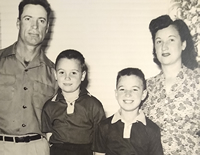 Rosie had always wanted to go on a plane ride, so one day I sprung a surprise flight to Boise from Reno on her. Thad and David were also enjoying the ride as I pointed out landmarks we flew over. They were fascinated with the four engines. Kevin must have come by his love of travel, as he was in “the basket,” although we didn’t know it at the time.
My job ended in Fallon, but brother Irv said there was work for me at the Iron Mine near Lovelock. Rosie and the boys didn’t want to move, but I promised the kids I’d get a house near their schools, and sure enough, we were right beside both schools.
Kevin was born in Lovelock in December of 1955. We had some great times in Lovelock. Rosie and I became involved in Methodist Church Fellowship with the teenagers, Cub Scouts, and Little League.
We lived through many disasters, too: a miscarriage; Thad Jr. got electrocuted at the Little League park and was saved by a quick-thinking coach; David split a shin open and had 21 stitches; Kevin had a bone felon operation; I lost a finger in the conveyor belt at the mine and ended up in the hospital with Thad Jr., who had an emergency appendectomy operation.
After the mine closed, I went to work on a road job. I had promised Rosie that if I ever had to move again, we would move to Gerber, CA, to be near her sister Neva.
One day, while working on a backhoe, finishing up an irrigation project, I had a flashback to combat and destroyed almost all the work we had done on the project. I got off the tractor, went to the office, and asked for my pay. I said, “I’m done, and once you see what I’ve done, you’ll know why.” I never told them I had flashed back to war that day.
I just went home and told Rosie that it was time to move to California. We ended up right across the street from my brother-in-law, Emmet (Nick) Nickles (who I just missed in France at the hospital), my sister-in-law, Neva, and their three daughters.
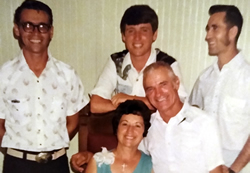
I worked for Dudley Sand and Gravel in Gerber, CA, for a while, but even though I loved the work, the pay was too low, and they refused to give me a pay raise. So, I ended up applying, getting hired, and working for Par Gas in Los Molinos, CA. With better financial and medical coverage, we were able to buy a 10-acre ranch in El Camino. We bought two Black Angus cows and named them Bossy and Sassy. Those two cows produced nearly 20 head of cattle for us to butcher or sell. Kevin had a palomino horse named Dusty, and with his dog Corky and a garden filled with vegetables, our family life on the Ranch was complete.
Eight years into working for Par Gas, I began having vision problems in my right eye. I had surgery to repair a detached retina, but it was unsuccessful. My wife asked the doctor if shrapnel could have been the cause, and he confirmed that the metal he pulled out was indeed related to injuries I incurred when I was blown up at the Our River.
Having lived with nightmares and rage for several decades, Rosie said it was time to get help. With the loss of my eye and my early retirement from Par Gas, we needed professional help. We found a woman named Dora Stevens who worked for the DAV (Disabled American Veterans). She helped me prove my service and that my wounds were war-related. You see, my records had been burned in a fire at the National Headquarters, so she contacted Congressman Howard “Bizz” Johnson, and they were successful in getting my records restored while also qualifying me for both disability pay and medical treatment.
I was referred to a psychiatrist who instructed me to put all my horrors of the war on paper in the form of an Autobiography.
It took several years of therapy, but it was a blessing and has eased the pain in my soul. I still have nightmares, but now I can put them in their place and live a more peaceful life.
I don’t know why God chose to keep me alive while so many others gave of theirs.
Those who gave all are the true heroes, not me. They will never share another laugh, hug, kiss, or find the joy of life that I have. Some never even had the opportunity to find their true love, get married, and have children to surround them with love, as I have.
I have dedicated my life to serving and honoring their memories. I have been a life member of the Veterans of Foreign Wars (VFW) and the American Veterans (AMVets) in Corning, CA. I have served as honor guard, performing burial services for our fallen comrades. I have been blessed to have the Corning AM Vets renamed the SGT Thad Blanchard Post. My deceased son David has also been honored by the Corning VFW, which has renamed its post the SGT David Blanchard Post.
I was honored by Local, State, and Federal Representatives with Plaques and Certificates for my dedicated service to the men and women who still serve this country.
I was honored to be interviewed by students from Corning High School who videotaped me and sent the video to the Smithsonian Institution for a Public Archive of men and women who served and fought in WWII.
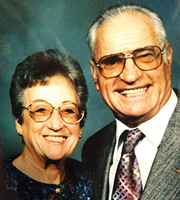
I lost my little Freckle-Face in January of 1996. My dancing partner and the Angel of my life. Our family has never been the same without her.
My Children have blessed me with many Grandchildren and great-grandchildren.
I currently reside at Oakdale Heights Assisted Living in Redding, CA. The staff here take super good care of me. I love them all as if they are my own.
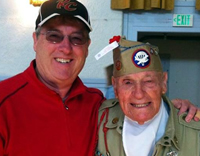
I will be (God willing) turning 100 years old on March 3, 2022. My wish is to make a final parachute jump in Memory and Honor of all my comrades who fought and died for the Freedom of this Country.
My son Kevin, Granddaughter Mindy, and friend Mike Ramirez will honor me by jumping with me on Saturday, March 5, 2022, at Rolling Hills Casino Golf Course in Corning, CA.
God has blessed me, shown me mercy, and guided me through some of the most challenging times of my life.
— Thad Blanchard
Thad fell on Veterans Day, November 11th, 2021, and separated his artificial right hip for the second time in four days. On Friday, November 12th, he was rushed to Mercy Hospital due to blood flow problems discovered by the Staff and Nurse at Oakdale Heights.
A scan of his body revealed the news that this would be his final day on Earth. His son Kevin sent word out to the family to come fast. Almost all of his immediate family came to the Hospital to say a final “I Love You.”
It only seems fitting that this dedicated Soldier’s last days would involve Veterans Day as he dedicated his life to serving them so diligently!
He passed away peacefully at 6:30pm on November 12, 2021.
© Kevin Blanchard, All Rights Reserved